Results
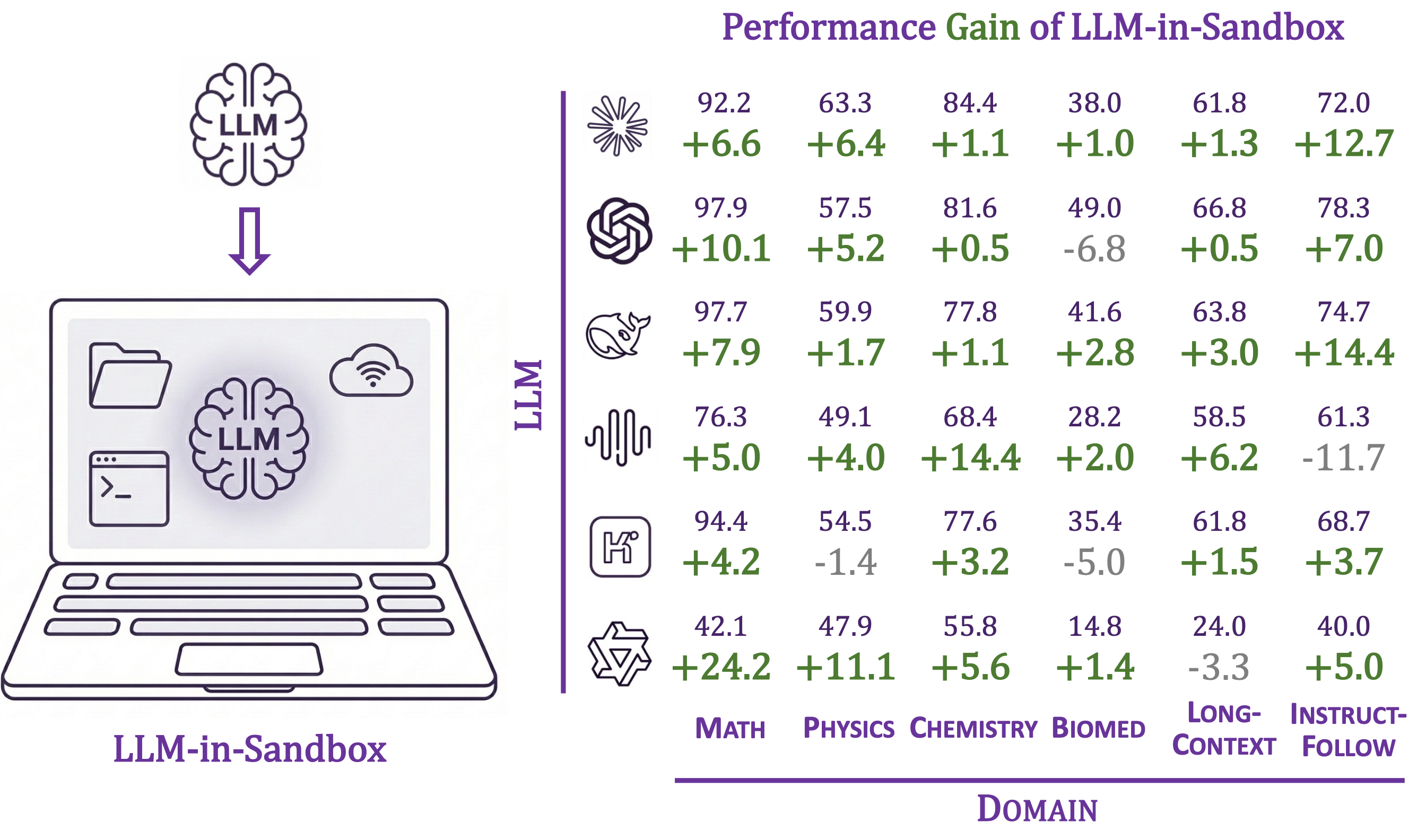
Generalization across diverse LLMs and Domains
Daixuan Chengαβ, Shaohan Huangβ, Yuxian Guγ, Huatong Songα, Guoxin Chenα
Li Dongβ, Wayne Xin Zhaoα, Ji-Rong Wenα, Furu Weiβ
αGSAI, Renmin University of China βMicrosoft Research γTsinghua University
We introduce LLM-in-Sandbox, enabling LLMs to explore within a code sandbox (i.e., a virtual computer), to elicit general intelligence in non-code domains. We first demonstrate that strong LLMs, without additional training, exhibit generalization capabilities to leverage the code sandbox for non-code tasks. For example, LLMs spontaneously access external resources to acquire new knowledge, leverage the file system to handle long contexts, and execute scripts to satisfy formatting requirements. We further show that these agentic capabilities can be enhanced through LLM-in-Sandbox Reinforcement Learning, which uses only non-agentic data to train models for sandbox exploration. Experiments demonstrate that LLM-in-Sandbox, in both training-free and post-trained settings, achieves robust generalization spanning mathematics, physics, chemistry, biomedicine, long-context understanding, and instruction following. Finally, we analyze LLM-in-Sandbox's efficiency from computational and system perspectives, and open-source it as a Python package to facilitate real-world deployment.
Watch LLM-in-Sandbox solve a chemistry problem: converting IUPAC names to SMILES notation
Task: Given a chemical compound's IUPAC name, identify the correct SMILES representation from multiple choices. The agent downloads PubChem package and uses it to convert the name to SMILES. Gold Answer: A
Generalization across diverse LLMs and Domains
Convert IUPAC chemical names to SMILES notation
Solve complex geometry problems with code assistance
Generate text following strict formatting constraints
Analyze multiple documents to answer complex questions
Create a 3-day Tokyo trip itinerary with interactive map
Design a promotional poster for a tech conference
Create a birthday countdown video with animations
Compose original ambient piano music with MIDI
If you find our work helpful, please cite us:
@article{cheng2026llm,
  title={Llm-in-sandbox elicits general agentic intelligence},
  author={Cheng, Daixuan and Huang, Shaohan and Gu, Yuxian and Song, Huatong and Chen, Guoxin and Dong, Li and Zhao, Wayne Xin and Wen, Ji-Rong and Wei, Furu},
  journal={arXiv preprint arXiv:2601.16206},
  year={2026}
}